
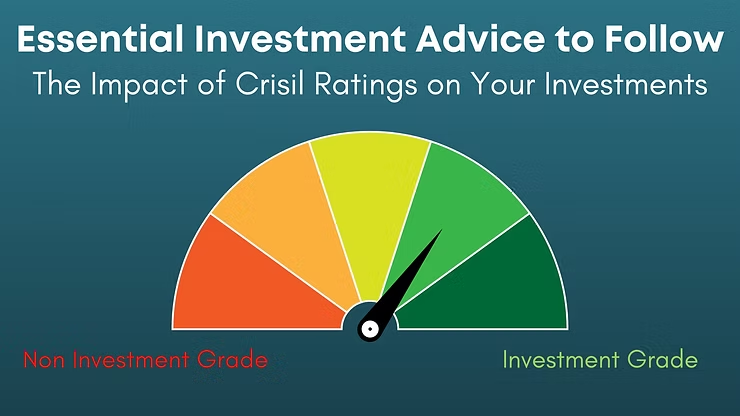
Understanding Credit Ratings Credit ratings estimate the likelihood of an entity, whether that be a company or government, fulfilling its obligations to repay principal and interest on the due dates. These ratings are provided by independent agencies that are not involved in the investment instrument, which ensures that they are impartial when assessing credit risk. Credit rating agencies in India must obtain a license from SEBI and meet strict criteria and procedures to maintain compliance. Currently, only six rating agencies, specifically CRISIL, ICRA, CARE, India Rating, Acuite and Infomerics, are approved by SEBI.
Understanding the Rating Scale
Credit ratings are an assessment of the credit risk that is associated with fixed-income securities such as corporate bonds and securitized debt instruments (SDIs). These ratings are divided into two main groups: Investment Grade and Speculative Grade. The higher the rating, the less risk of default associated with the instrument. For a better understanding of CRISIL rating scale, please refer to the table below:
CRISIL | Rating Description | Grade |
CRISIL AAA | Securities with this rating are considered to have the highest degree of safety regarding timely servicing of financial obligations. Such securities carry lowest credit risk. | Investment-grade |
CRISIL AA | Securities with this rating are considered to have high degree of safety regarding timely servicing of financial obligations.Such securities carry very low credit risk. | Investment-grade |
CRISIL A | Securities with this rating are considered to have adequate degree of safety regarding timely servicing of financial obligations.Such securities carry low credit risk. | Investment-grade |
CRISIL BBB | Securities with this rating are considered to have adequate degree of safety regarding timely servicing of financial obligations.Such securitiescarry low credit risk. | Investment-grade |
CRISIL BB | Securities with this rating are considered to have moderate risk of default regarding timely servicing of financial obligations | Non-investment grade or High yield bonds or Speculative Grade |
CRISIL B | Securities with this rating are considered to have high risk of default regarding timely servicing of financial obligation | Non-investment grade or High yield bonds or Speculative Grade |
CRISIL C | Securities with this rating are considered to have very high risk of default regarding timely servicing of financial obligations. | Non-investment grade or High yield bonds or Speculative Grade |
CRISIL D | Securities with this rating are in default or are expected to be in default soon. | Non-investment grade or High yield bonds or Speculative Grade |
Investment Grade:
Understanding Investment Grade Ratings When an investment receives a rating above ‘BBB-‘, known as an Investment Grade rating, it indicates that the investment carries a relatively low level of credit risk. This suggests that there is a strong probability that the issuer will fulfill its financial obligations by making timely interest and principal payments.
Non-Investment Grade:
Understanding Non-Investment Grade Ratings When an investment is associated with a higher level of credit risk, it is classified as a non-investment grade rating. Any rating below ‘BBB-’ is considered non-investment grade.
Take a look at the table below, which displays the average constant default rate (CDR) for various CRISIL rating categories over a two-year period:
Average CDRs for ratings on structured finance instruments (FY 1993-2023)-Annual static pools
Rating Category | Avg. CDRs(Two Years) |
CRISIL AAA (SO) | 0.13% |
CRISIL AA (SO) | 0.57% |
CRISIL A (SO) | 2.34% |
Source: CRISIL: Avg, CDRs for ratings on structured finance instruments (FY 1999-2003
The Importance of Credit Ratings for Investors
Credit ratings are a critical tool for investors, providing an easy way to compare different investment opportunities. By providing a single score that encompasses all aspects of credit risk, investors can effectively evaluate their options. Consider the following tips when using credit ratings to make investment decisions:
For lower risk, opt for a higher credit rating
For lower credit ratings, expect higher returns to offset the risk
We offer corporate bonds and SDIs are credit-rated by SEBI-approved agencies, providing investors with a range of choices rated AA to BB, with returns of 10-16% according to the risk-taking ability of the customer.
Are you looking for any of the debt instruments, please Contact Us for available and suitable options for your risk appetite, tenure, expected returns.